
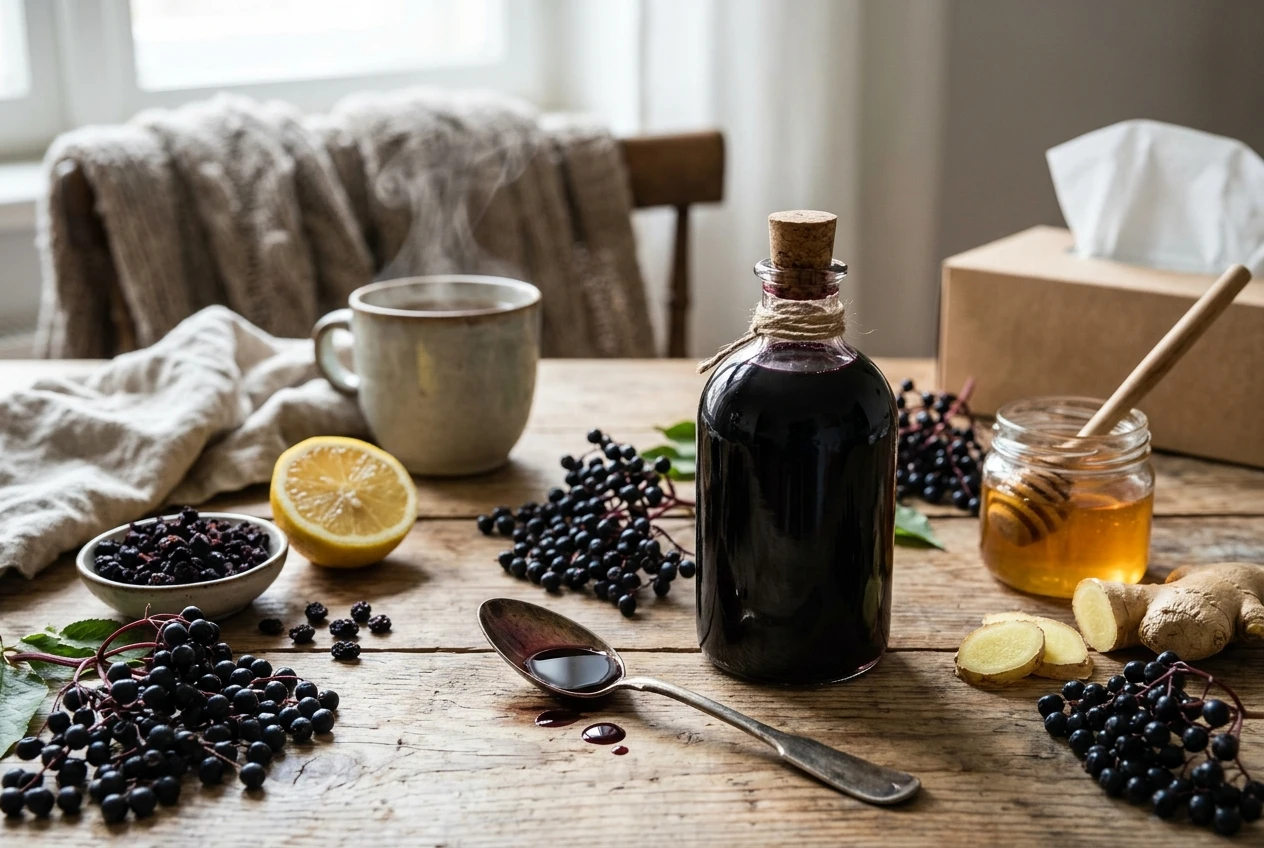
If you’re asking whether elderberry syrup actually works for colds, the most accurate answer is a cautious maybe. A few small human trials found that people taking elderberry extract had shorter colds or milder symptoms. None of that supports the bigger claims you’ll see online, such as prevention, “beating” the flu, or a stronger immune system.
This article goes through each popular claim and compares it to what researchers actually measured. It then covers safety, who should skip elderberry, and how to buy a product without being misled by the label.
Where the elderberry hype came from and why it spread so fast
Elder has a long history in European folk medicine, where the flowers and berries were made into teas, cordials and syrups. That history gives elderberry a ready-made reputation as a “natural” cold remedy, and a product with that reputation is easy to market.
A few things make it spread well online. The syrup is dark, sweet and pleasant to take, so it feels like a remedy rather than a chore. Parents can give it to children more easily than a capsule. It is also easy to make at home, which produces a steady stream of recipe videos with confident captions.
The trouble is that a short video has room for a conclusion and no room for a study design. “Elderberry shortened colds in a small trial” turns into “elderberry kills viruses,” then into “take it daily so you never get sick.” Each step drops a little of the evidence, and by the end the claim no longer resembles the research.
“Boosts your immune system”: what that phrase does and doesn’t mean
“Boosts immunity” is the most common elderberry claim, and it is the hardest to test. Immunity is not a single dial. It involves many cell types and signals, and more activity is not automatically better. An overactive immune response is part of what causes allergies and autoimmune disease.
Lab studies have shown that elderberry compounds can affect immune signaling in cells and animals. That is a reason to run human trials, but it does not show a benefit to a person with a cold. Results in a dish often fail to carry over to people.
When a product says it “supports” or “boosts” immunity, there is usually no clinical measurement behind it, such as fewer infections or fewer sick days. A claim you can check is “shortened the cold by about X days in a trial.” A claim you cannot check is “strengthens your defenses.” For a broader comparison of herbal and supplement options aimed at immunity, see natural supplements vs. herbal remedies for immunity.
What human trials measured: duration, severity and prevention
Most elderberry trials ask one of three questions. Each has a different level of support.
Does it shorten a cold or flu?
This is where the best-known results are. A frequently cited trial of people with influenza symptoms, with roughly 60 participants, reported that those given an elderberry preparation recovered sooner than those given a placebo. A trial of air travelers, with just over 300 participants, found that those taking elderberry extract who developed a cold had a shorter illness than those taking a placebo.
A review that pooled a handful of these trials, covering under 200 participants in total, concluded that elderberry may reduce upper respiratory symptoms. The word “may” matters there. The reviewers were describing a signal that justifies more research, not a settled result.
Does it ease symptoms?
Some trials scored symptoms such as cough, congestion, aches and fever, and found lower scores in the elderberry group. Symptom scores are self-reported, which makes them useful but subjective. People who expect a remedy to help sometimes report feeling better even on a placebo, which is why the placebo group matters.
Does it prevent colds?
The evidence here is weakest. The air travel trial did not show that elderberry stopped people from catching colds. Its finding concerned how long the colds lasted and how bad they were once they started. No solid trial shows that taking elderberry every day keeps you from getting sick.
Does it beat the flu?
The flu trials looked at symptom relief in people already ill, and they were small. They do not show that elderberry replaces a flu vaccine or antiviral medication prescribed by a doctor. If you are at higher risk from flu, such as being older, pregnant, or having a chronic condition, elderberry is not a substitute for medical care.
Why the studies are hard to compare
Even when several trials point the same way, they are hard to add together. Three problems come up repeatedly.
- Small samples. Trials with dozens or a few hundred people can produce results that shrink or disappear in larger studies. A small trial can also exaggerate an effect by chance.
- Different products. Researchers have used syrups, lozenges, capsules and standardized extracts. These differ in how much of the active material they contain, so a result for one product does not automatically apply to another.
- Different doses and timing. Some participants started taking elderberry at the first sign of symptoms, while others took it for days before travel. The amount, the schedule and the duration all varied.
Several of the trials were also funded or supported by companies that make elderberry products. That does not make the results wrong, but it is a reason to want independent replication, which is still thin.
The practical consequence is that no one can say how much to take, in what form, or for how long, based on the research. If a website gives you an exact elderberry dose as if it were proven, treat that as a guess from the manufacturer rather than a finding.
Raw berries, cooked syrup and gummies: safety and preparation
Preparation matters because of how the plant is built. The raw berries, along with the leaves, stems, bark and roots of the elder plant, contain compounds that can release cyanide-related toxins. Eating raw or unripe berries can cause nausea, vomiting and diarrhea.
Cooking breaks these compounds down, which is why traditional recipes simmer the berries before straining them. If you make syrup at home, use ripe berries of the correct species, remove all stems and leaves, and cook the berries thoroughly. Do not eat raw berries or add raw berries to smoothies.
Species matters too. Black elder (Sambucus nigra) is the one used in most research. Other elder species can look similar, and some are not considered suitable for eating. If you are not able to identify the plant with confidence, buy a commercial product instead of foraging.
Here is how the common forms compare:
- Homemade syrup: The berries are cooked, but the strength varies from batch to batch, and it usually contains a lot of sugar or honey. It keeps only a limited time in the fridge.
- Commercial syrup: More consistent, though sugar content varies. Check the label.
- Gummies: Easy to take, but they are also candy. They often contain less elderberry than people assume, and the amount may be hard to find on the label.
- Capsules and extracts: These are closest to what some trials used, but products vary widely.
One more point for parents: syrups made with honey are not safe for babies under one year old, because honey can carry spores that cause infant botulism. Most elderberry research was done in adults, so evidence for young children is limited. Ask a pediatrician before giving it to a child.
Who should skip it or ask a clinician first
Elderberry is generally well tolerated when it is properly cooked and used for a short time. Even so, some groups should check with a doctor or pharmacist before using it.
- Pregnant or breastfeeding people. There is not enough safety data to say it is fine.
- People with autoimmune conditions or on immunosuppressant medication. Because elderberry may affect immune signaling, clinicians often advise caution. The concern is partly theoretical, but it is a reason to ask first.
- Young children. Ask a pediatrician about the product and amount, and avoid honey-based syrup for infants.
- People with diabetes or anyone watching sugar intake. Many syrups contain a good deal of added sugar.
- Anyone taking regular medications. A pharmacist can check for interactions, and it is better to ask than to assume an herb is harmless.
- People with a known allergy to elder or related plants.
Stop taking elderberry and contact a clinician if you develop stomach upset that does not pass, a rash, swelling, or trouble breathing.
How to shop for a product without falling for label claims
Labels on herbal products are written to sell, so read them for specifics instead of adjectives. These checks are practical and take only a minute.
- Look for the species name. The label should say Sambucus nigra or black elderberry. “Elderberry blend” with no species is less informative.
- Find the amount per serving. Some products state the milligrams of extract or the amount of berry juice concentrate. A product that lists only a proprietary blend gives you nothing to compare.
- Check the sugar. Look at added sugars per serving, especially if you are giving it to a child or taking it daily.
- Read the other ingredients. Syrups often include zinc, vitamin C, echinacea or other herbs. If a product combines several, you cannot tell which one is doing anything, and the trial evidence for elderberry may not apply to the mix.
- Look for third-party testing. A seal from an independent testing organization shows the contents were verified, though it does not show the product works.
- Be wary of disease claims. In many places, supplements are not allowed to claim they treat or cure illness. A label that promises to “cure the flu” or “prevent colds” is a warning sign about the seller.
Price is a weak guide. A more expensive syrup is not more effective by default, and a cheap one can be fine if the label is clear and honest.
A realistic way to use it, and when to see a doctor instead
Based on the trials, the most reasonable use is short-term and started early in a cold, not as a year-round daily habit. Most of the positive results came from people taking elderberry for a few days around the onset of illness, not from long-term prevention. Follow the directions on your chosen product, because there is no research-backed standard dose.
Keep your expectations modest. If elderberry helps, the likely benefit is a slightly shorter or milder cold, not a skipped one. Rest, fluids and time still do most of the work. For a sore throat in particular, there are other options you can compare, such as the ones in how to treat a sore throat naturally.
Do not use elderberry as a reason to wait on medical care. See a doctor if:
- A fever is high or lasts more than a few days.
- Symptoms get worse after seeming to improve.
- You have trouble breathing, chest pain, or a cough that will not stop.
- A baby, an older adult, or someone with a chronic illness or weakened immune system becomes sick.
- Symptoms last more than about ten days.
In short, elderberry syrup has some modest human evidence for easing colds and no good evidence for the dramatic claims. If you decide to try it, buy a clear, well-labeled product, never eat the berries raw, and check with a clinician if any of the caution groups above applies to you.
Read our guide on daily herbal rituals to keep your immune system strong, and see how elderberry fits alongside habits with better support.