
If you are standing in front of a supplement shelf, the labels make the choice look harder than it is. One bottle says turmeric, the next says curcumin, a third says curcumin with black pepper extract, and the prices run from a few dollars to several times that. This article explains what separates them, so the turmeric vs curcumin supplement decision rests on what your body can actually take in.
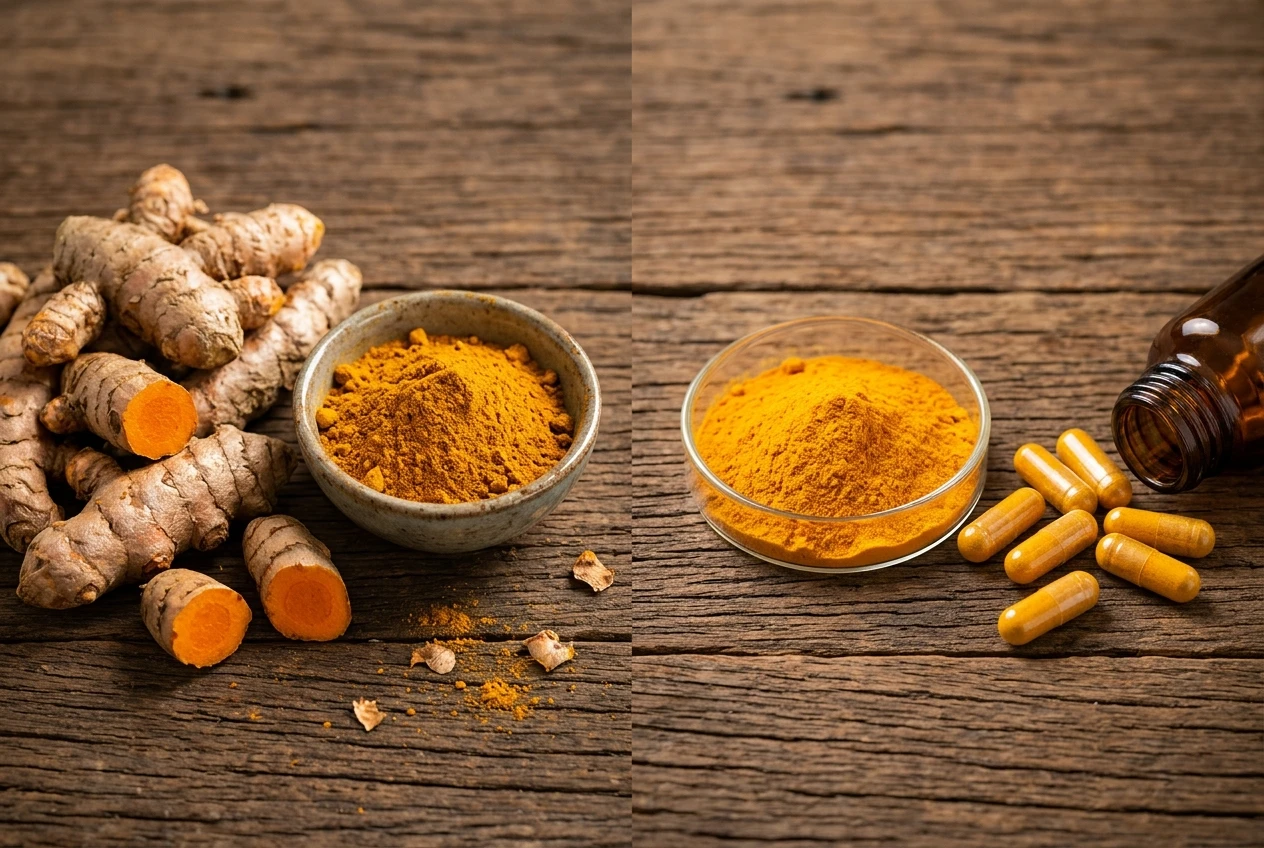
Turmeric and curcumin are not the same thing: what is actually in the root
Turmeric is the root of Curcuma longa, a relative of ginger. Dried and ground, it becomes the yellow-orange spice in curries. The root contains starch, fiber, essential oils (including compounds called turmerones), and a group of pigments called curcuminoids.
Curcumin is the main curcuminoid, and it is the compound most research focuses on. It is also a small share of the whole. Turmeric powder is commonly cited as containing only a few percent curcuminoids by weight, and the exact figure varies with the plant, where it was grown and how it was processed. Most of what is in a spoonful of turmeric is something else.
So the two words on a label describe different products:
- Turmeric powder or whole-root capsules contain the ground root, with curcumin as a minor part.
- Curcumin supplements are usually extracts concentrated to a high curcuminoid content, often labeled as 95 percent.
A capsule labeled “turmeric 500 mg” and one labeled “curcumin 500 mg” can therefore deliver very different amounts of curcumin. Check which one you are holding before you compare prices.
Why curcumin is so hard for your body to absorb
Curcumin has several properties that work against it. It does not dissolve well in water, and your digestive tract is a watery environment. It is also unstable in some conditions, and what does get absorbed is broken down and cleared quickly. The liver and the gut wall chemically modify curcumin and send it on for removal, so little of the original compound reaches the bloodstream.
In studies where people take plain curcumin by mouth, blood levels of the free compound are typically very low. That is the central problem behind the supplement market: a compound with interesting lab results that the body barely lets through.
This does not automatically mean unabsorbed curcumin does nothing. Some of it stays in the gut, where it could act locally, and the research on that is much less developed than the research on blood levels. What it does mean is that the same dose of curcumin can behave very differently depending on what it is taken with and how it is made.
What black pepper and fat really do to absorption
Two things are used to improve the odds: piperine and fat.
Piperine is the compound that makes black pepper pungent. It slows the processes that chemically modify curcumin in the liver and gut wall, so more of it survives in a usable form. The figure most often quoted comes from a small, often-cited human study from the 1990s, in which 2 grams of curcumin taken with 20 milligrams of piperine produced a much larger rise in blood levels than curcumin alone. It was a small study on a handful of volunteers, but the direction of the effect has been repeated in other work.
Fat helps because curcumin dissolves in fat far better than in water. Taking it with a meal that contains some fat, such as olive oil, eggs, yogurt or nuts, gives it something to dissolve in. Traditional cooking has long combined turmeric with oil and pepper, and the chemistry suggests why that pairing is sensible.
There is a catch with piperine. The same enzyme-slowing action that helps curcumin can also change how your body handles some medications, raising their levels in the blood. That matters in the safety section below.
Kitchen turmeric powder: what it can and can’t do for you
Cooking with turmeric is a reasonable habit. A teaspoon of powder weighs roughly 3 grams, and at a few percent curcuminoids that gives you on the order of tens of milligrams of curcumin. Studies of curcumin supplements usually use hundreds of milligrams to a gram or more per day, so culinary amounts are far lower.
That does not make the spice pointless. You also get the root’s other compounds, and you get them in food, usually alongside the fat and black pepper that cooking tends to supply. Turmeric in a pan of oil-sautéed vegetables, a lentil dish or a golden milk made with whole milk and a pinch of pepper is a sound use of the powder.
What kitchen turmeric cannot do is match the dose in the studies people cite when they buy supplements. If a product’s marketing quotes research on a 500 to 1,000 milligram curcumin extract, a sprinkle on your dinner is not the same intervention. Eating it is a food choice, and nothing wrong with that, but it should not be expected to behave like a concentrated extract.
One practical note: spice quality varies, and powder from a source you trust is worth the small extra cost. Fresh root, grated into cooking, works too and stains everything yellow.
Standard capsules, piperine blends and enhanced formulas: how to read the label
Supplement labels fall into roughly three groups.
Standard turmeric or curcumin capsules
These contain either ground root or a curcumin extract with nothing added to help absorption. Whole-root capsules give you a low curcumin dose. Plain extract capsules give you more curcumin, but with the absorption problem described above. Taking either with a fat-containing meal is the cheapest improvement available.
Piperine blends
These add black pepper extract, often listed as piperine, BioPerine or “black pepper extract.” The label should state how many milligrams of curcuminoids and how many of piperine are in each serving. Since the piperine effect is well documented, this is the simplest upgrade over a standard capsule. It is also the form that carries the medication-interaction concern.
Enhanced formulations
These change how the curcumin itself is delivered. Common approaches include binding it to lecithin (a phytosome), packaging it in tiny lipid droplets or micelles, reducing particle size, or blending it with turmeric’s essential oils. Manufacturers often report much higher blood levels than for plain curcumin, and some of those results come from small human studies.
When you read an enhanced product’s label, check for these points:
- Curcuminoids per serving, not just “turmeric extract” or a proprietary blend total.
- Serving size, since some products need two or three capsules to reach the stated dose.
- The delivery method named on the label, and whether the maker points to a human study of that specific product, not of curcumin in general.
- Third-party testing, such as a USP or NSF seal, which checks that the contents match the label. Turmeric products have a history of adulteration in the wider spice trade, so independent testing carries real value.
Higher absorption does not mean you should take more. Enhanced products can reach higher blood levels at lower label doses, so follow the manufacturer’s serving instructions rather than comparing milligrams across brands.
What human studies show, and where the evidence is thin
The most promising human research on curcumin involves osteoarthritis pain, especially in the knee. Several trials report modest reductions in pain compared with placebo, and some compare curcumin favorably with common pain relievers over short periods. Research on other conditions, including metabolic markers and general inflammation, is more mixed.
The limits are considerable:
- Many trials are small and short, often running weeks to a few months.
- Studies use different products, doses and delivery methods, so results cannot be pooled neatly.
- Some trials are funded by the companies that make the product tested.
- Blood levels of curcumin do not necessarily track with symptom relief, and researchers are still working out how it acts.
- Results for one branded formulation do not carry over to a different one.
A fair reading is that some people may get modest benefit for joint discomfort from a well-absorbed curcumin product, and that the evidence does not support big promises. If you want a wider look at how herbs compare in the research on lasting inflammation, the article on herbs for chronic inflammation goes through which have human evidence and which are only trending.
Who should be careful: medications, gallbladder issues and pregnancy, and when to ask a pharmacist or doctor
Turmeric as a food is generally well tolerated. Concentrated supplements are a different matter, and a few groups should check first.
- Blood thinners and antiplatelet drugs. Curcumin may affect clotting. If you take warfarin, clopidogrel or similar medicines, or you have surgery scheduled, ask before using a supplement.
- Diabetes medication. Curcumin may lower blood sugar, which could add to the effect of your medicine.
- Medications affected by piperine. Because piperine can change how drugs are processed, it can raise the blood levels of some prescriptions. A pharmacist can check your list against it.
- Gallbladder problems. Turmeric may stimulate the gallbladder to contract, so anyone with gallstones or a blocked bile duct should speak to a doctor first.
- Pregnancy and breastfeeding. Food amounts are considered fine, but concentrated supplements have not been studied well enough to call safe, so ask your doctor.
- Liver concerns. There are rare reports of liver injury linked to turmeric supplements, particularly concentrated and high-absorption ones. If you have liver disease, or you notice dark urine, yellowing of the skin or unusual fatigue while taking one, stop it and seek medical advice.
- Iron levels. Turmeric may reduce iron absorption, which is worth raising if you are being treated for low iron.
A pharmacist is a good first call, since they can see everything you take, including over-the-counter products and other herbs. Bring the supplement bottle with you so they can read the label.
A practical way to choose between powder, capsules and enhanced curcumin
Start with what you want from it.
If you want turmeric as part of eating, use the powder or fresh root. Cook it with oil and a pinch of black pepper. This is low cost and low risk, and it makes no claim to be a therapeutic dose.
If you want to try a supplement for everyday joint aches, choose a curcumin product with a clear label: curcuminoids per serving stated, absorption method named (piperine or an enhanced formulation, not both unless the label explains the dose), and independent testing. Take it with a meal containing fat. Avoid products that list only a “proprietary blend.”
If you take any prescription medication, talk to a pharmacist before buying anything with piperine or an enhanced formula, since those are the products most likely to interact.
Whatever you pick, give it a fair trial of several weeks at the labeled dose, and note whether anything has changed. If it has not, stopping costs you nothing, and the powder in your kitchen is still useful for cooking.
For more on herbs and everyday inflammation, see the site’s guide to natural remedies for inflammation, and compare what you find there with what the research supports before you spend money on another bottle.