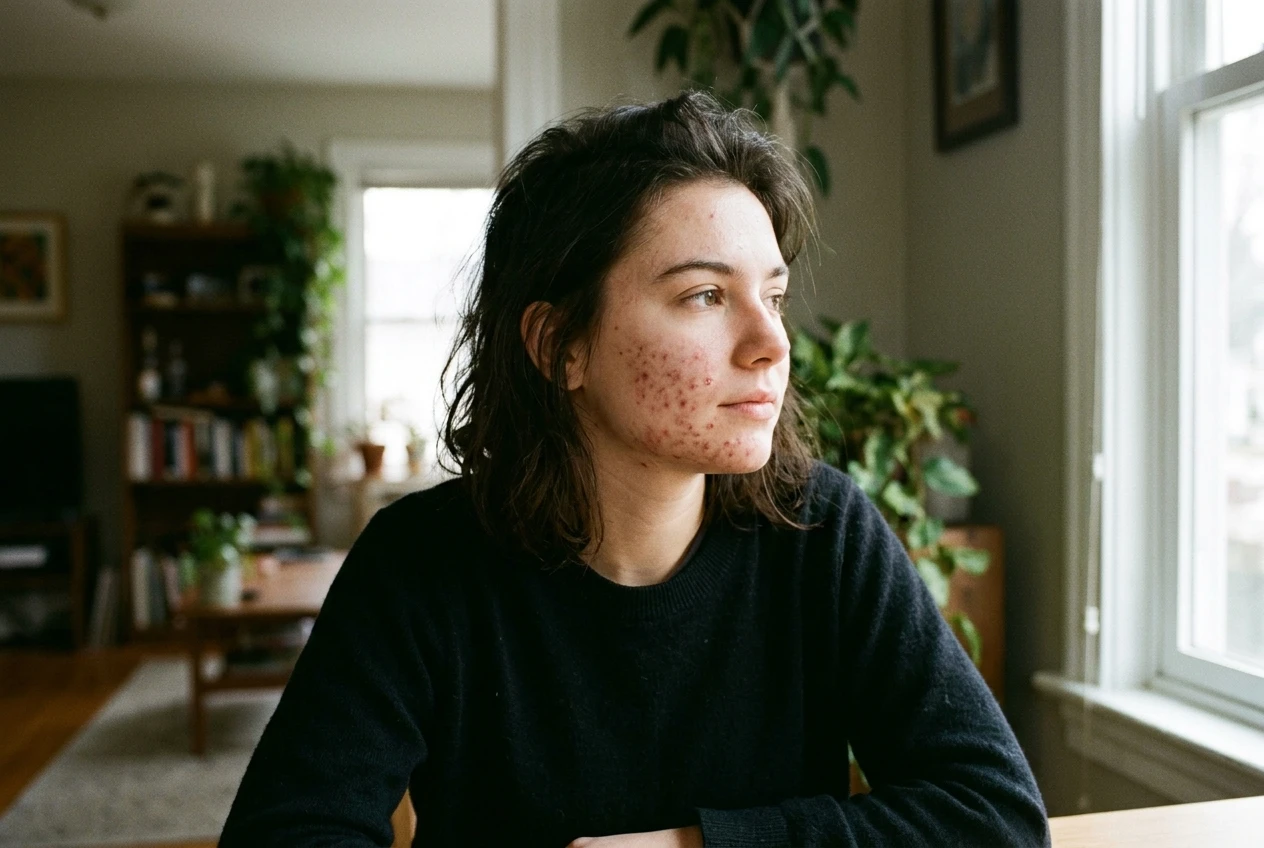
Hormonal acne tends to show up along the jawline, chin and lower cheeks, and it often flares in the week or two before a period. It is driven largely by how oil glands respond to androgens (hormones such as testosterone), so the pimples are often deep, tender and slow to clear. Surface cleansing does little for them, which is why the usual “detox your skin” advice fails.
That also limits what herbs for hormonal acne can do. Most were never studied for acne itself, and the trials that exist are small. What follows sorts each herb by the job it might do, and says how much evidence sits behind it.
Two jobs an herb might do
An herb could act on hormone signals, meaning androgen levels or cycle-related hormone shifts. Or it could act on inflammation, which makes existing pimples redder and more painful. These are different mechanisms, and an herb that does one does not necessarily do the other. Matching the job to your pattern is more useful than choosing whatever is trending.
Spearmint tea and androgens
Spearmint is the herb with the most direct hormonal signal. A couple of small, short human trials in women with excess facial and body hair found that drinking spearmint tea twice a day lowered free testosterone in blood tests. Those trials ran from several days to about a month.
The limits are large. The participants had hirsutism, not acne, so nobody has shown that spearmint clears breakouts. The trials were small and short, and the visible changes were modest. Spearmint tea is cheap and low risk for most people, which makes it reasonable to try. Treat it as an experiment, not a proven treatment.
Vitex (chasteberry) for cycle-linked breakouts
Vitex is mainly studied for premenstrual symptoms such as breast tenderness and mood changes. It is thought to act on the pituitary gland, which influences cycle hormones. Evidence for acne specifically is weak, and much of it comes from older, lower-quality studies.
It may suit someone whose breakouts clearly follow their cycle, alongside other premenstrual symptoms. Because it affects hormone signaling, several groups should skip it or ask a doctor first:
- Anyone pregnant, trying to conceive or breastfeeding
- Anyone using hormonal birth control or fertility treatment
- Anyone with a hormone-sensitive condition
- Anyone taking dopamine-related medication, including some drugs for Parkinson’s disease or psychosis
Green tea, turmeric and licorice for inflammation
Green tea has the best case in this group. Small studies have tested green tea extract, mostly applied to the skin, and some saw fewer lesions. Drinking the tea is gentle, but concentrated green tea extract capsules have been linked to liver problems in rare cases, so avoid high-dose capsules without medical advice.
Turmeric has plausible anti-inflammatory activity, but acne-specific human evidence is thin. Absorption also varies a lot by form, which I cover in turmeric powder versus curcumin capsules. It can add to the effect of blood thinners.
Licorice is the one to be most careful with. Taken by mouth it can raise blood pressure and lower potassium, and the acne evidence does not justify that risk for most people. Skip it if you have high blood pressure, heart or kidney problems, or take diuretics or blood pressure medication.
Matching an herb to your acne pattern
- Breakouts along the jaw all month, possibly with extra facial hair: spearmint tea is the most relevant option, and it is worth mentioning the hair growth to a doctor.
- Breakouts that cluster before your period, with other premenstrual symptoms: vitex is the herb studied for that pattern, if none of the exclusions above apply to you.
- Red, swollen pimples that look inflamed more than oily: green tea, drunk as tea, is the gentler inflammation option.
To test one herb safely, follow these steps:
- Change one thing at a time. Starting three herbs together tells you nothing about which one worked.
- Take a photo weekly in the same light, and note your cycle day, since breakouts naturally rise and fall.
- Give it 8 to 12 weeks, because a pimple takes weeks to form and clear.
- Stop at once if you get a rash, stomach upset, headaches or changes in your period.
Check labels before you buy. Look for a standardized extract so the dose is consistent, third-party testing for purity, and no proprietary blends that mix in other hormone-active herbs.
Signs you need a doctor, not another tea
See a doctor if you have painful deep nodules or cysts, scarring or dark marks, or acne that started suddenly in adulthood. Irregular periods, new facial or body hair, or thinning scalp hair can point to a condition such as PCOS, which needs testing. The same goes for acne that has not improved after 12 weeks of a trial.
If you take prescription acne treatment, spironolactone, birth control, blood thinners or blood pressure medication, ask a pharmacist about each herb first. Herbs are active substances, and interactions are real.
Before buying anything, run through the label checklist above (standardized extract, third-party testing, no hormone-interacting blends), then browse our picks for spearmint tea and vitex that meet it.