
Tart cherry juice has become a standard suggestion in sleep articles, wellness feeds and the supplement aisle. The claim sounds reasonable: cherries contain melatonin, and melatonin is the hormone people associate with sleep. Before you spend money on a bottle of juice, a jar of concentrate or a tub of capsules, it helps to know what the research on tart cherry juice for sleep actually covers.
Why tart cherry juice keeps showing up in sleep advice
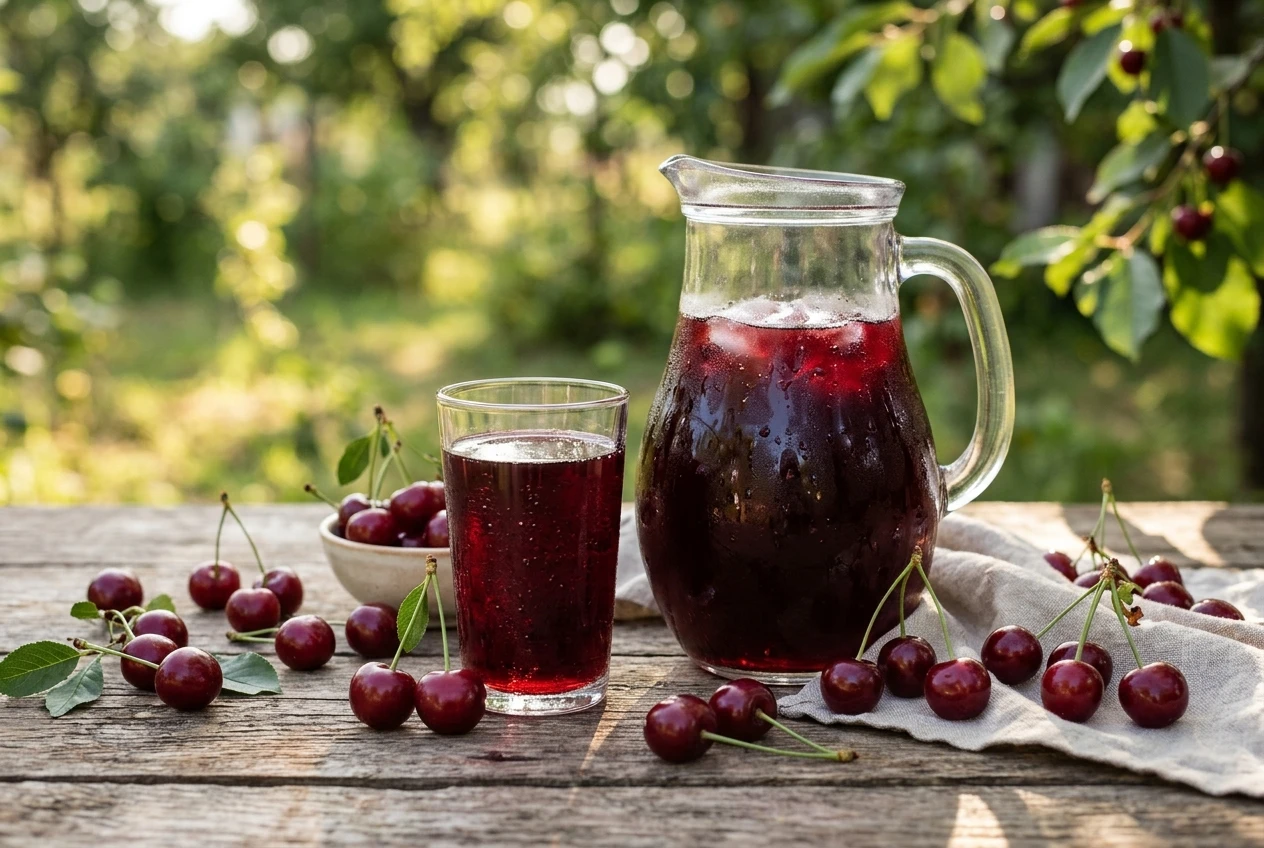
Three things keep tart cherry in the conversation. It is a food, so it feels gentler than a pill. It contains melatonin naturally, which gives it an easy explanation. And a handful of small human studies reported better sleep measures in people who drank it, which gave writers something to cite.
Those studies are real, but they are modest, and most advice articles repeat the headline and skip the details. That gap is where buying mistakes happen. The details tell you how much confidence the evidence deserves, and they tell you what to look for on a label.
What the human trials tested, and how small and short they were
The published human trials on tart cherry and sleep share a recognizable pattern. They enrolled small groups, generally somewhere between about a dozen and a few dozen adults. They ran for short periods, usually one to two weeks. Participants drank tart cherry juice or a diluted concentrate, typically twice a day, and the researchers compared sleep measures with a placebo drink or with a baseline period.
Some trials recruited adults who already had insomnia symptoms. Others recruited healthy adults. Some used questionnaires, some used wearable or lab-based measurements, and some looked at a melatonin marker in urine. The results leaned positive, but the outcomes were measured in different ways, so the trials are hard to compare directly.
Here is what that design can and cannot tell you:
- Small groups make results unstable. One or two unusual participants can shift an average, and a result that appears in 20 people often shrinks or vanishes in larger samples.
- Short durations say nothing about month three or month six. You can’t tell whether any effect lasts or fades.
- Specific products were used. Most trials used Montmorency tart cherries, often in a standardized form supplied by a manufacturer. A different juice at a different strength is not the same test.
- Funding and sourcing matter. Several tart cherry studies have involved the cherry industry and suppliers. That does not make them wrong, but it is a reason to want independent replication.
A fair summary is that the early results are encouraging and preliminary. They justify a cautious personal trial. They do not justify treating tart cherry as a proven fix for insomnia.
Melatonin in cherries: what that explains and what it doesn’t
Tart cherries do contain melatonin, and that is the most common explanation offered for the sleep results. It is plausible, but there are limits to how far it goes.
The amount of melatonin in a serving of juice is small and varies with the cherry variety, growing conditions, and processing. Melatonin supplements are dosed in a way that a glass of juice is not designed to match. So it is not established that the melatonin in the juice accounts for any benefit seen in the trials.
Researchers have also proposed other contributors, including plant polyphenols that may affect inflammation and the availability of tryptophan, an amino acid involved in making melatonin. These are hypotheses. The trials were not built to separate one mechanism from another.
This matters when you shop. If a label or ad says “naturally rich in melatonin,” ask how much, because a claim without a number gives you nothing to compare. Dosing is rarely stated on juice labels, which is one reason juice is harder to evaluate than a capsule with a listed amount.
Juice, concentrate or capsules: comparing sugar, serving size and cost per serving
The three forms deliver the same fruit in very different packages. Compare them on three points.
Sugar
Juice is the form most likely to bring a noticeable amount of sugar, because you drink a glass of fruit liquid. Read the nutrition panel and look at grams of total sugar and added sugar per serving. Some bottles are 100 percent tart cherry juice, while others are cherry-flavored blends sweetened with other juices or sugar. Concentrate contains the same fruit sugars in a smaller volume, and you dilute it. Capsules usually contain very little sugar, because the fruit is dried and powdered, but the amount of fruit per capsule varies widely.
Serving size
The serving size on the label may not match what the trials used, and it may not match what you will actually pour. A bottle that lists a small serving can look cheap and low in sugar until you realize you would drink more than that. For concentrate, check how much you are meant to dilute. For capsules, check how many make one serving, because the label might list a “serving” of two or three capsules while the front of the bottle highlights a per-capsule figure.
Cost per serving
Skip the sticker price and calculate it yourself: divide the price by the number of servings in the container, using the serving size you would actually take. This is the only fair way to compare a bottle of juice, a jar of concentrate and a tub of capsules. Concentrate often works out cheaper per serving than ready-to-drink juice, but check it rather than assuming.
Cost per serving also decides how affordable a two-week trial is. You don’t need to buy the largest container to find out if it works for you.
How to read a tart cherry label
Labels vary a lot in how clear they are. Look for these:
- The cherry type. Montmorency is the variety used in most of the human research. A label that just says “cherry” or “cherry flavor” gives you no basis for comparison. Sweet cherry juice is a different product.
- Juice percentage. Look for “100% tart cherry juice” or “from concentrate” stated plainly. Phrases like “cherry juice drink” or “cherry cocktail” signal a diluted, often sweetened product.
- Added sugar. The nutrition panel lists it separately. If added sugar appears, you are paying for sweetener as well as fruit.
- Amount of fruit per serving. For capsules and powders, look for a stated quantity of tart cherry, ideally in milligrams or as a juice-equivalent figure. A “proprietary blend” that lists total weight without breaking out each ingredient tells you very little.
- Blends with extra herbs. Many sleep products combine tart cherry with valerian, chamomile, melatonin, magnesium or others. A blend makes it impossible to tell which ingredient you are reacting to, and each added ingredient brings its own cautions. If you want to test tart cherry itself, buy it on its own.
- Third-party testing. A seal from an independent testing organization suggests the contents match the label, though it does not prove the product works.
Who should check with a doctor first
Tart cherry juice is a food, but a concentrated serving twice a day is more than casual snacking. Talk to a doctor or pharmacist before trying it if any of these apply:
- You manage blood sugar, including diabetes or prediabetes. Juice and concentrate deliver fruit sugar in liquid form, which absorbs quickly.
- You take prescription medication, especially for sleep, anxiety, blood pressure or blood thinning. Ask whether a new daily supplement could interact.
- You already take melatonin or other sleep aids. Stacking them makes it harder to know what is working.
- You are pregnant or breastfeeding, or giving anything to a child.
- You have a sensitive digestive system. Cherries contain sorbitol, which can cause loose stools or cramping in some people.
Persistent trouble sleeping is also worth raising with a doctor, whatever you try. Sleep problems can stem from conditions like sleep apnea, restless legs or depression, and a drink at night will not address those.
Where tart cherry fits next to valerian, lavender and lemon balm
The herbs people usually compare tart cherry with work differently. Valerian, lavender and lemon balm are taken for calming or relaxing effects, and they come as teas, capsules, tinctures or oils. Tart cherry is a fruit product with a food-like serving. Each has its own cautions and its own quality of evidence. If you are considering valerian, the guide to valerian root dosage and timing covers who should skip it. For a scent-and-sip approach, there is a lavender bedtime routine, and for restlessness and a busy mind, a look at lemon balm for nighttime anxiety.
Tart cherry can be a reasonable first thing to try if you prefer a food-based option and your main concern is occasional trouble falling or staying asleep. Because it is a single ingredient with a clear serving, it is also easy to test properly.
A simple two-week test
- Pick one product with a clear label: Montmorency tart cherry, no added sugar, no extra herbs.
- Use the label’s serving size, once or twice a day as directed, with the evening serving an hour or two before bed.
- Keep your other habits steady. Hold your bedtime, caffeine, and alcohol roughly constant so you can see any change.
- Take notes each morning. Record roughly how long it took to fall asleep, how often you woke, and how rested you felt, on a simple 1 to 5 scale.
- Compare week two with the days before you started. If you see no change, stop and save your money. If you notice a difference, it is still one person’s two weeks, so treat it as a useful signal and not a guarantee.
If you want to compare tart cherry against the herbs that have human trial evidence, the next step is to read which herbs have human trial evidence for sleep, covering valerian, chamomile, lavender and ashwagandha.