Many people notice the same pattern in the evening. The day’s tasks are done, the house is quiet, and the body still feels switched on: a busy mind, tight shoulders, a low hum of unease. Lemon balm (Melissa officinalis) is one of the oldest herbs used for that state, and it has a modest but real body of human research behind it. This article covers what that research supports, which form to choose, how to test it fairly, and who should leave it alone. Lemon balm for anxiety
Why your mind speeds up at night, and where lemon balm fits in
Evening is when the distractions stop. Work, errands and screens had been absorbing your attention, and once they fall away, unfinished worries get the room to themselves. Caffeine taken in the afternoon, a late heavy meal, alcohol, and bright screens close to bedtime can each add to the jittery feeling. Chronic stress keeps the body’s alert systems running higher than they need to be.
Lemon balm is a leafy member of the mint family. Traditionally it has been drunk as a tea to settle nerves and an unsettled stomach. Researchers have looked at its extracts for calmness and mood, and lab work suggests its compounds act on the brain’s GABA system, the same signaling pathway that many calming and sedating drugs act on. That mechanism is worth knowing about, but lab findings do not tell you how a cup of tea will feel at 9 p.m. For that you need human trials.
What human studies on lemon balm and anxiety have actually found
The honest summary is that the results lean positive, and the evidence is thin.
Several small trials gave healthy volunteers a single dose of a standardized lemon balm extract and then measured mood and performance under mild lab stress. Some of these found higher self-rated calmness after the larger doses. A few longer trials, lasting a matter of weeks, used lemon balm alone or in a combination product in people with mild to moderate anxiety or poor sleep, and reported improvements in symptom scores.
Those findings come with limits you should know about:
- Small groups. Many trials enrolled a few dozen people or fewer, which makes results easy to overstate.
- Short duration. Weeks, not months. Nobody knows much about long-term effects from trial data.
- Extracts, not tea. Most studies used concentrated, standardized extracts. A cup of tea from a supermarket bag is a different, usually weaker, preparation.
- Combination products. Lemon balm is often tested together with valerian, hops or other herbs, so you cannot credit the result to lemon balm alone.
- Self-reported outcomes. Anxiety is measured by questionnaires, which are influenced by expectation and by a calming ritual.
So the fair reading is that lemon balm may take the edge off mild anxiety and restlessness for some people. It has not been shown to treat an anxiety disorder, and no trial supports using it in place of medical care for one.
Anxious and restless versus can’t sleep
These are related problems, but they call for different tools.
Lemon balm fits best when the trouble is the wired, uneasy state before bed: you feel tense, your thoughts keep looping, and you want to feel calmer so that sleep can arrive by itself. It is a calming herb, and it does not knock you out the way a sleep medication does. Some people feel a little drowsy, but that is a side effect and not the main aim.
It suits you less if the problem is sleep itself: waking at 3 a.m., sleeping at the wrong hours because of shift work, loud snoring or gasping, or lying awake for hours every night for months. Those patterns have causes that a tea will not touch. Persistent insomnia deserves a conversation with a doctor, partly because sleep apnea, depression and thyroid problems can all look like “can’t sleep.”
If sleep is your main complaint and you want to see how herbs compare for it, our roundup of what human trials show for sleep herbs is the better starting place.
Tea, tincture or capsules: choosing a form and a realistic evening routine
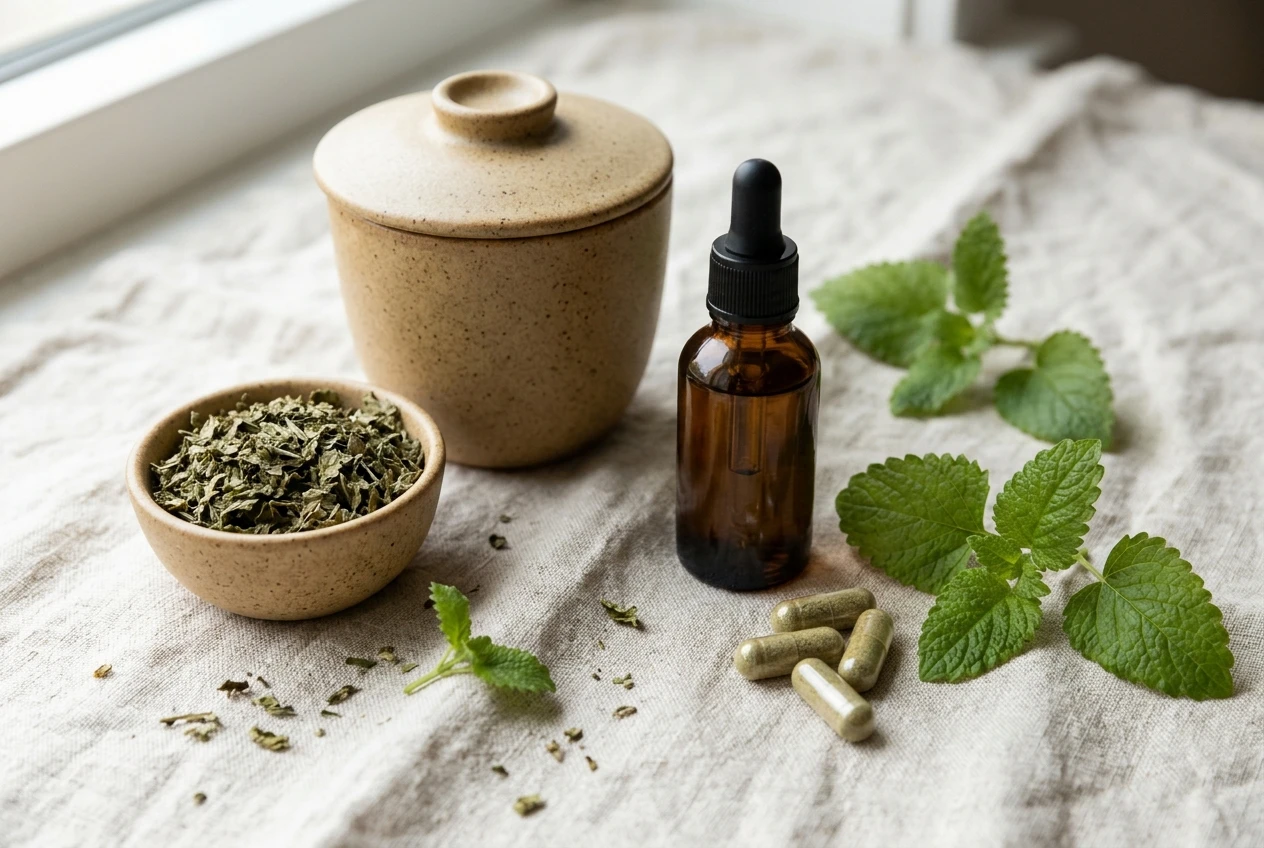
The three forms differ in strength, consistency and convenience.
Tea
Tea is the gentlest and the most pleasant, and the ritual itself can help you wind down. Use a covered cup and steep for around ten minutes so that the aromatic compounds stay in the water instead of escaping as steam. Dried loose leaf is usually stronger than the bagged version, though bag strength varies by brand. The drawback is that you cannot easily know how much active material you are getting.
Tincture
A tincture is a liquid extract, usually made with alcohol. It is quick to measure, easy to travel with, and typically stronger than tea. Dose depends on the concentration of the product, so follow the label and not a number from an article. The alcohol content matters if you avoid alcohol, take medication that interacts with it, or are driving later. Some brands make glycerin-based versions that skip the alcohol.
Capsules
Capsules are the closest match to what the trials used, particularly when the label names a standardized extract and states the amount per capsule. They are tasteless and consistent. They also give you no ritual, and quality varies between brands, so look for a clear ingredient list that names the plant part and the extract ratio, and for testing by an independent lab.
A realistic evening routine
Take lemon balm about 30 to 60 minutes before you want to feel settled, not at the moment you get into bed. Pair it with the habits that help whatever you take: dim the lights, put the phone down, and keep caffeine to the morning and early afternoon. If you choose tea, make it the last thing you drink in the evening, since a large mug close to bedtime can send you to the bathroom at night.
How to try it for two weeks and tell whether it’s helping
A plain two-week test tells you more than guessing. Some effects of lemon balm in trials appeared within hours and others took weeks, so two weeks is long enough to see whether it does anything for you without committing to months of it.
- Spend the first three or four evenings on a baseline. Change nothing and write down, each night, how tense you feel on a scale from 1 to 10, how long it takes you to settle, and what you had to drink that day.
- Start one product at one consistent time. Use the same form and the same time each evening. Do not add other supplements or new habits in the same fortnight, or you will not know what worked.
- Keep scoring every night. Add a note on how you feel the next morning, including any grogginess, stomach upset or headache.
- Compare at the end. Look at the average of your scores, not your best or worst night. A drop of a point or two that holds across the fortnight is a meaningful signal. No change is also a useful answer.
If you feel no difference, stop. Taking more than the label suggests is not a good way to force a result. If you feel worse, or if anxiety is getting in the way of daily life, speak with a doctor.
Who should be careful: thyroid conditions, sedating medications, pregnancy, and when to see a doctor
Lemon balm is generally well tolerated in trials, and reported side effects tend to be mild: nausea, dizziness, stomach upset, or sleepiness. Still, a few groups should check first.
- Thyroid conditions. Lab studies suggest lemon balm extracts may interfere with how thyroid-stimulating hormone acts on the thyroid. If you have a thyroid disorder or take thyroid medication, ask your doctor or pharmacist before using it regularly.
- Sedating medications. Sleep aids, anti-anxiety drugs, certain antidepressants, anticonvulsants and similar medicines can combine with lemon balm to cause extra drowsiness. Check with a pharmacist before combining them.
- Pregnancy and breastfeeding. There is not enough reliable safety data, so the usual advice is to avoid concentrated lemon balm products unless a clinician approves.
- Before surgery. Because of the possible added sedation, tell your care team about any herbal products you take ahead of a procedure.
- Children. Dosing and safety are not well established, so ask a pediatrician.
See a doctor if your anxiety is constant and not limited to the evening, if it comes with panic attacks, chest pain, a racing heart, or low mood, if you are using alcohol to cope, or if poor sleep continues beyond a few weeks. An herb is a reasonable thing to try for mild, occasional restlessness. Ongoing symptoms deserve a proper assessment.
How lemon balm stacks up against chamomile, valerian and ashwagandha
Each of these herbs has a different profile, and they are best understood as separate tools.
Chamomile is mild and very familiar, usually drunk as tea. It has some trial support for anxiety and for sleep quality, and it overlaps most with lemon balm in feel. People who dislike lemon balm’s slightly sharp, citrusy taste often prefer it.
Valerian is aimed more directly at sleep than at calming a busy mind. Results across trials are mixed, and some people dislike the smell. If sleep onset is your main problem, our guide to taking valerian root for sleep covers timing and who should skip it.
Ashwagandha is an adaptogen taken daily over weeks, and it targets general stress load more than the evening moment. It works on a different timescale than a cup of lemon balm tea. If daily stress is what drives your evening tension, see how much ashwagandha to take when your days are packed.
Lemon balm sits in the gentle, short-term, evening-calming corner. It can be used alone or after a conversation with a clinician alongside another herb, but start with one at a time so you can see what each one does.
Want to compare lemon balm with other calming herbs? Read our breakdown of what human trials show for valerian, chamomile, lavender and ashwagandha.