
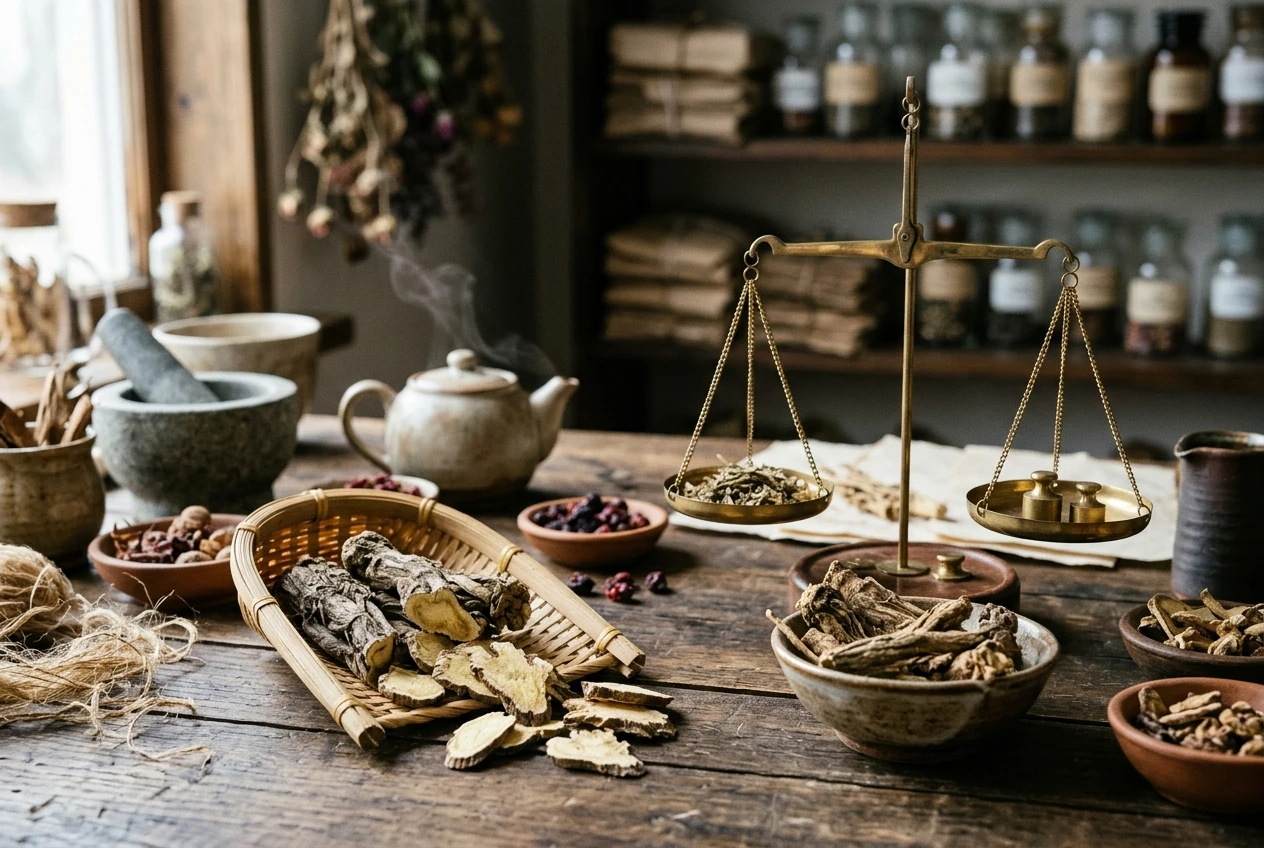
Is dong quai safe? For some healthy adults, short-term use of a well-labeled product may carry low risk, but it is not safe for everyone. It can interact with blood thinners, is advised against in pregnancy, and has no reliable evidence as a hormone balancer. Check your medications and health history before buying.
What is dong quai, and what has it traditionally been used for?
Dong quai is the root of Angelica sinensis, a plant from the same family as celery, carrot and parsley. In traditional Chinese medicine it has been used for centuries, usually in formulas with other herbs, for women’s concerns such as irregular or painful periods and for general weakness. It is sometimes nicknamed “female ginseng,” a label that suggests more certainty than the evidence supports.
Traditional use is a reason to take an herb seriously, but it does not establish that the herb is safe for you. Traditional practitioners also matched herbs to the individual and combined them in specific preparations. A single-herb capsule bought online is a different thing from a formula built around one person’s pattern of symptoms.
Does dong quai actually balance hormones?
There is no reliable evidence that dong quai balances hormones. Laboratory work has suggested the root contains compounds with weak estrogen-like activity, but results have been mixed, and lab findings do not tell you what a capsule does in a person. In a small placebo-controlled trial of dong quai alone for menopausal hot flashes, the herb did no better than placebo.
Most human research has also tested dong quai inside multi-herb formulas, which makes it hard to say what any single ingredient contributes. “Hormonal balance” is also a loose phrase. It can mean irregular cycles, PMS, perimenopausal symptoms or something else, and each of those has different possible causes that deserve a proper assessment.
This article makes no promise that dong quai will change your cycle, your mood or your symptoms. The useful question is whether you can use it without harm, which depends on who you are.
Who should skip dong quai entirely?
Skip dong quai if any of the following applies, unless a clinician who knows your history tells you otherwise:
- You are pregnant or trying to conceive. Dong quai has traditionally been avoided in pregnancy because it may stimulate the uterus, and safety data are lacking.
- You are breastfeeding. There is not enough reliable information on its safety for nursing infants.
- You take a blood thinner. Dong quai contains coumarin-type compounds, and reports suggest it may increase warfarin’s effect. Other anticoagulant and antiplatelet drugs deserve the same caution.
- You have a bleeding disorder. An herb that may affect clotting adds risk.
- You are allergic to celery, carrots, parsley or related plants. Dong quai belongs to the same plant family, so cross-reactions are possible.
- You have surgery scheduled. Bleeding risk is a concern, so tell the surgical team about every supplement you take.
Who should talk to a clinician or pharmacist first?
If you fall in this group, ask before buying, because the answer depends on details only a professional with your records can weigh. A pharmacist is often the fastest place to start, since checking interactions is part of the job.
Talk to a professional first if you:
- Have a history of a hormone-sensitive condition, such as breast, uterine or ovarian cancer, endometriosis or fibroids. Because of the possible estrogen-like activity, this is not a guess to make alone.
- Use hormonal birth control, hormone replacement therapy or a hormone-blocking drug such as tamoxifen.
- Take any prescription medication, especially drugs processed by the liver, since herbs can change how the body handles them.
- Have liver disease, or have had abnormal liver tests.
- Have heavy periods, bleeding between periods or cycles that have changed suddenly. These symptoms need a diagnosis before any supplement.
- Take other herbs or supplements, particularly ones that also affect clotting, such as ginkgo, garlic or high-dose fish oil.
- Are giving an herb to a child or an older adult.
Bring the exact product label, not just the herb’s name. Strength and added ingredients change the answer.
What should you check before you buy a dong quai product?
Check the label first, because supplement quality varies and the label is your main evidence. In the United States, supplements are not approved by regulators before they are sold, so the burden of checking falls on the buyer.
Use this list before you pay:
- The Latin name. It should say Angelica sinensis. Other Angelica species are different plants with different traditions.
- The full ingredient list. Many products blend dong quai with other herbs, and each added herb brings its own cautions. A simple single-ingredient product is easier to judge.
- Third-party testing. Look for a seal from an independent testing organization such as USP or NSF, or a published certificate of analysis. A seal does not prove the herb works, only that the contents match the label more closely.
- The part of the plant and the form. Root is the traditional part. Capsule, tincture, tea and extract differ in strength, so you cannot swap them by weight.
- A clear dose and a manufacturer you can contact. Avoid labels with vague “proprietary blend” amounts and no company details.
- Claims. Be wary of any product promising to “fix,” “reset” or “cure” hormones. Responsible labels do not claim that.
What does a careful trial look like if you decide to try it?
A careful trial is for a healthy adult who is not pregnant, takes no medications, has none of the conditions above, and has still run the product past a pharmacist. If that describes you, the aim is to make any problem easy to spot and easy to stop.
- Change one thing at a time. Do not start dong quai in the same week as another new supplement, or you will not know which one caused a reaction.
- Use the lowest dose on the label. Do not exceed it. More is not better, and no one has established a dose that suits everyone.
- Keep it short. Long-term safety has not been well studied, so decide on an end date before you begin and treat it as a short experiment.
- Keep a simple log. Write down the date, the dose, and any symptoms, including bruising, bleeding, skin changes, digestion and sleep. If you are tracking a cycle, note that too, but remember a change does not prove the herb caused it.
- Protect your skin. Some compounds in plants of this family can make skin more sensitive to sun in some people, so use sunscreen and cover up outdoors.
- Stop before any procedure. Tell your dentist or surgeon, and ask when to stop.
Which warning signs mean you should stop?
Stop taking dong quai and contact a clinician if you notice unusual bruising, nosebleeds, bleeding gums, blood in urine or stool, or a period that is much heavier or longer than usual. Those can signal an effect on clotting or on your cycle that should not be waited out.
Also stop and get advice if you develop:
- A rash, or a burn-like skin reaction after time in the sun
- Persistent nausea, vomiting, diarrhea or stomach pain
- Dizziness, unusual drowsiness or headaches that are new for you
- Yellowing of the skin or eyes, dark urine or severe fatigue, which can point to liver trouble
Hives, swelling of the face or throat, or difficulty breathing are signs of a serious allergic reaction. Seek emergency care immediately rather than waiting to see if it passes.
What are gentler options for cycle comfort?
For general cycle comfort, start with options that have lower interaction risk and clearer information about what they do. None of them replaces a medical evaluation if your symptoms are heavy, painful or changing.
- Heat, gentle movement and regular sleep help with cramps and PMS discomfort for many people, and carry no interaction risk.
- Herbal teas such as ginger or chamomile are traditional comfort drinks. Our guide to herbal tea for menstrual cramps covers what to sip and when.
- Evening primrose oil is a common PMS supplement. Our post on what the GLA research says about evening primrose oil and PMS explains what it can and cannot do, and who should check first.
- Vitex is another traditional herb used for cycle support, and it works on a different timeline from dong quai. Our Vitex guide covers that in detail, along with its own cautions.
Every herb on this list still needs the same check against your medications and conditions before you buy it.
Your next step
Before you buy any herb, write down your medications and conditions and take the check-first list from this article to your pharmacist or clinician. Then read our Vitex timeline guide for a different traditional approach to cycle support.